The opening and closing of ocean basins are a fundamental process in the theory of plate tectonics. Most episodes of fragmentation of the last supercontinent Pangea were relatively shortly preceded (within∼10 Myr) by the emplacement of Large Igneous Provinces, indicating a close link between lithospheric ruptures and mantle plumes. However, the role of mantle plumes in this process remains debated. While passive rifting driven by external tectonic forces is well understood, the possibility of purely active rifting, where a rising plume alone tears a continent apart, has received little attention.
Using the open‐source dynamic modelling code ASPECT 2.5.0, this study systematically tested whether a mantle plume can completely break a continental plate without any external pull (Fig. 1). The experiments show that such a scenario is physically possible, but only under very specific conditions: the plume must be exceptionally buoyant and continuously fed from the deep mantle, while the overlying continental lithosphere must be unusually hot and weak.
Encouragingly, the models did reproduce successful continental break-up within less than 10 million years after plume arrival, matching the timing observed in many real-world examples from the breakup of the supercontinent Pangea. However, the required combination of an extremely buoyant plume and an overheated plate is geologically rare. Therefore, while purely active rifting can occur in theory, it is unlikely to have been the dominant mechanism during the last 500 million years. Instead, the break-up events that shaped our modern oceans were probably driven by a combination of plume activity and external tectonic force. This work refines our understanding of how continents split and highlights the importance of multi-factor controls in plate tectonics.
The results were published on Jan 27, 2026, in Journal of Geophysical Research: Solid Earth under the title “Numerical modeling of purely active (plume‐produced) continental rifting and break‐up.” The first author and corresponding author is Alexander Koptev, assistant professor at School of Earth Sciences and Engineering at Nanjing University. It is a long-term collaboration with scientists from leading European institutions and universities. Co-authors include Alessio Lavecchia, Sierd Cloetingh, Michaël Pons, Enrico Marzotto, Sascha Brune, István Kovács, Magdala Tesauro, Fred Beekman, Qin Wang, Stephan V. Sobolev, Claudio Faccenna, and Laurent Jolivet.
This research was supported by Research Grant Hungary, the ERC MEET Grant, the DFG Grant and the European Union (ERC, EMERGE).
Full article is available at: https://doi.org/10.1029/2025JB033048
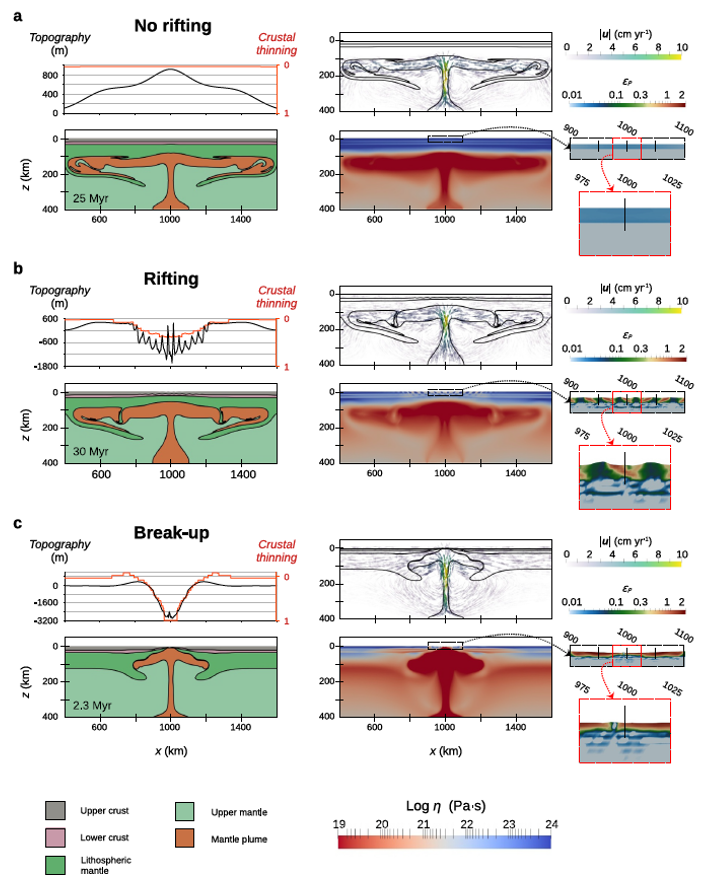
Fig. 1. Typical evolutionary modes observed in numerical simulations.(a) “No rifting” mode. (b) “Rifting” mode. (c) “Break‐up” mode. The left panels present the compositional field, surface topography, and crustal thinning (defined as the ratio of current to initial crustal thickness). The central panels depict the viscosity distribution along with the velocity field. The right panels display the accumulated plastic strain within the regions outlined by the dotted rectangles in the central viscosity panels.